
The Fell Pony Shoulder
- Articles
- Education
-
Aug 08
- Share post

Why has no one bred for the perfect shoulder

On the left, a well laid back shoulder on a Fell Pony, annotated to show the slope, and a steeper shoulder on the right on another Fell Pony.

Sometimes the angles in the shoulder area are referred to generally rather than in the specific terms shown here. Each of them, however, contributes slightly differently to an equine’s style of movement.

In the context of equine conformation, the word shoulder typically refers to the collection of bones, muscles and joints found in the general vicinity of the front of the animal.

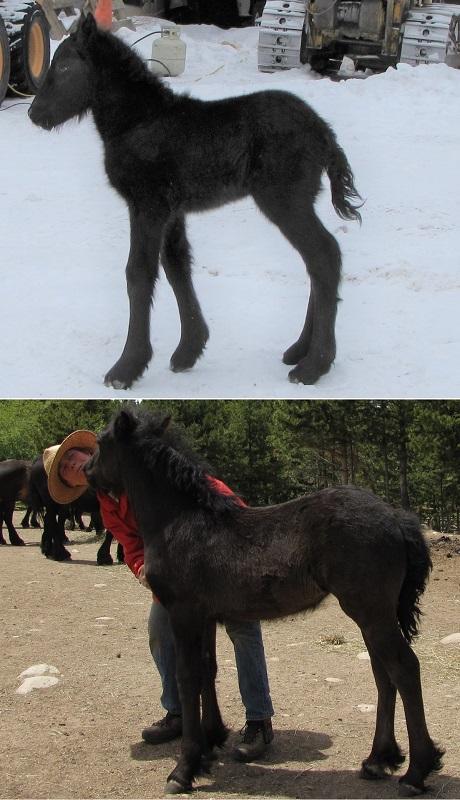
Foals out of a steep-shouldered mare by different stallions. I felt the first stallion corrected the shoulder in the top foal, but a different stallion wasn't able to correct the shoulder in the bottom foal.
While both have admirable knee action, the shoulder of the pony on the left is more bound. It appears to have a shorter shoulder blade and not be as laid back.
I was told once by a long time Fell Pony enthusiast and breeder that “People have never gone for the perfect shoulder.”
That’s odd, I thought. The shoulder is mentioned in the breed standard. It is fundamental to our ponies’ abilities to do the work they’ve historically done. And it is crucial to our ponies’ way of going. Why wouldn’t people attempt to breed for the perfect shoulder? After studying the shoulder for more than a decade, I now know the answer. The shoulder is complicated, and it’s tough to breed well for in isolation.
“In large measure, it is the functionality of a horse’s shoulders that dictates his style of movement.” (1)
I have been taught that proper Fell Pony movement has some action below (knees and hocks) without bouncing above (enabling bareback trotting races for instance.) I have seen this proper movement enough to know what it looks like as well as how seldom we see it. I’ve also learned that proper shoulder conformation is crucial to proper movement, and I’ve slowly been studying shoulder conformation to learn the specifics that allow proper movement. It turns out there are four characteristics that need to be present. No wonder ‘people have never gone for the perfect shoulder!’
Ponies are special because they move in ways that make them suitable for many different disciplines. They are different from draft horses and they are different from light horses. What we may not realize is that a pony’s shoulder is a key part of what sets ponies apart.
The historic uses of our breed have included riding, driving, packing, and draft work, roughly in that order in terms of frequency. (To read my previous article on equine shoulders and a variety of uses, click here.) For a pony to be a comfortable ride requires a particular shoulder conformation. And for a pony to be good looking when driving, some knee and hock action are desirable. It is, however, possible to get knee and hock action for driving in ways that make a pony less comfortable to ride.
Therefore, to get both riding and driving in a single pony requires a particular shoulder conformation. For packing, we want a free and easy stride which is also desirable for riding and driving. Regarding draft work, which I have the most experience with of these four areas of use, I think the ideal Fell Pony shoulder conformation is a little more challenging when it comes to proper harness fit, but with adequate muscling and knowledgeable harness fitting, draft work is definitely possible with these ponies.
In the Fell Pony Breed Description, shoulders count for 15 points in judging guidelines out of a total of 125. Movement, which is related, counts for 25 more points. One could argue, then, that the shoulder influences nearly one third of Fell Pony quality.
The Fell Pony Society Breed Description ( click here to view) says many things about the shoulder, including: “most important,” “well laid back and sloping,” “a good long shoulder blade,” and “muscles well developed.” I can certainly understand ‘most important’ since shoulder conformation is crucial to our breed’s movement and historic uses. It turns out that ‘well laid back and sloping’ is important to a good riding pony, as is ‘a good long shoulder blade.’ (Someday I’m sure I’ll learn why both ‘well laid back’ and ‘sloping’ are included in the description, since sloping seems inherent in well laid back, but not the other way around.) As I indicated already, a well-muscled shoulder can aid in harness fit for draft work and is obviously important in all kinds of work.
Regarding action, the breed description says “good knee and hock action, going well from the shoulder.” Unfortunately for me, this doesn’t say what the shoulder needs to look like for the action to be good. After seeing hundreds of Fell Ponies move in person and hundreds more in pictures and analyzing closely a select few dozen, I’ve come to some conclusions. In addition to a well laid back shoulder with a long shoulder blade, for a Fell Pony to move as I’ve been taught is proper, it needs an open shoulder and a humerus that is properly proportioned to the shoulder blade. But just what do well laid back, long, open, and properly proportioned mean?
In equines, the word shoulder doesn’t refer to just a bone or just a muscle or even just a joint.
In the context of equine conformation, the word shoulder typically refers to the collection of bones, muscles and joints found in the general vicinity of the front of the animal. There are two bones and three angles on each shoulder. The length of the scapula (or shoulder blade) and the upper arm (or humerus) are important, as are their lengths relative to each other. (For a detailed discussion of the bones and joints of the shoulder, click here.) All three angles are also important: the slope of the scapula (relative to horizontal), the angle between the scapula and the humerus, and the angle between the humerus and the front leg. (For a general discussion of the angles of the shoulder, click here.) While not strictly part of the shoulder, visually the withers are another important set of bones because they serve as a reference point. You can see in the photograph of the skeleton that the withers are actually the bony upward extensions of the vertebra. The elbow, also not strictly part of the shoulder, is a critical landmark for understanding shoulder function, despite it being at the top end of the forearm. To understand the shoulder, it is important to know where the important shoulder and related structures are. For a discussion of how to find them, click here.
You can see in the photograph of an equine skeleton the three different angles in the shoulder area: 1) the slope of the shoulder, 2) the angle of the shoulder, and 3) the angle of the forearm. Sometimes the angles in the shoulder area are referred to generally rather than in the specific terms shown here. Each of them, however, contributes slightly differently to an equine’s style of movement, especially a Fell Pony’s.
A sloping shoulder has better shock-absorption and provides a comfortable ride because it sets the withers back, so a rider is not over the front legs. (2)
…making the shoulder more horizontal (more ‘laid back’) –these horses tend to project forelimb movement to the front with a round movement style. (3)
The Fell Pony Breed Description says that the shoulder is to be well laid back and sloping. Ours is not the only breed that includes those words in their breed description. That’s because for riding, a laid back shoulder makes for a more comfortable ride as well as more reach for other uses as diverse as jumping, dressage, eventing, cutting, polo, driving, racing, and endurance. (4) So what is well laid back and sloping? The slope of the shoulder is measured relative to the horizon from the point of the shoulder to the peak of the withers as a proxy for the lay of the scapula. Sometimes the ideal angle is called oblique, and sometimes the ideal angle is given as a measurement of 45-50 degrees from the horizontal. I have found measurements to vary greatly depending on how the pony is stood and on what sort of ground, where the photograph is taken, etc., so I think developing an eye for what is well laid back and what is steeper is better than precise measurements. In the photo of the equine skeleton, would you consider that shoulder well laid back or steeper?
Upright shoulders are common and seen in any breed. An upright shoulder affects all sports. (5)
As a general rule we will see an upright shoulder angle give more knee action. (6)
While upright or steep shoulders are sometimes preferred for sprinting and certain other activities, generally speaking steep shoulders are not favored for riding. While they do allow for higher knee action, steep shoulders are nonetheless associated with a rougher ride because there are fewer good angles to act as springs when the front-end hits and then lifts off the ground. The stride can also be shortened because the equine cannot swing the leg as far forward as when the shoulder is more laid back. This shortening of the stride seems counter to the portion of the FPS Breed Description that says, “going well from the shoulder.”
My mentor Joe Langcake of the Restar Stud told me, “A straight shoulder knocks everything wrong in the pony.” And he said, “A straight shoulder is the hardest to breed out.” That latter one I have some experience with. I once owned a steep-shouldered mare whom I bought because I had a stallion that I thought could correct the shoulder. I was right – the foal was very nice. Unfortunately, I later learned both of the parents were FIS carriers, and my husband didn’t want me to breed them again for fear of having a foal we would have to euthanize. I then used my other stallion on the mare, and he wasn’t able to correct the shoulder. I ended up selling the mare on.
FPS Breed Description: ‘a good long shoulder blade’
A long shoulder blade, when it is well laid back, enables an equine to have a far-reaching stride and provide a smoother ride. The length of the shoulder blade can be approximated by measuring from the point of the shoulder to the high point of the withers. In the photograph here, two young Fell Ponies are shown at rest and at the trot. Both have significant knee action. The one on the left, though, doesn’t have quite the reach of the one on the right; its humerus doesn’t get quite as vertical. Its shoulder blade doesn’t appear to be quite as long in comparison and may not be quite as laid back, thus binding the shoulder somewhat and shortening the stride.
The angle of the shoulder and upper arm bone is the true measure of a horse’s gait. An open (90 degree or greater) angle allows the horse freedom of movement, and a gait that is a pleasure to ride. (7)
In terms of function, the more widely open the angle is at the point of shoulder, the more the horse’s forelimb ‘action’ will be displaced to the front, making it higher, more open and more free. (8)
While the FPS Breed Description doesn’t specifically mention the shoulder angle, the angle between the shoulder blade/scapula and upper arm/humerus is widely understood in conformation studies to be fundamental to good movement from the shoulder. The angle is approximated by measuring from the high point of the withers to the point of the shoulder to the elbow. In the many photographs I have analyzed of Fell Ponies that move as I have been taught is correct for our breed, the ponies all have open shoulder angles. In the photograph of the equine skeleton, would you consider the angle of the shoulder to be open?
It is not useful to discuss the conformation of the horse’s shoulder apart from the arm; both anatomically and functionally, the two limb segments must be considered together…. [The arm’s] length and resting angle are important determinants of your horse’s style of movement.” (9)
The shorter the humerus the choppier the gait, the longer the humerus tends to a smoother gait being more reaching with the front legs. When desiring a longer humerus we are looking for it to be at least 50% the length of the shoulder blade. (10)
To try to better understand good shoulder conformation in the Fell Pony, I found photographs of a few dozen ponies whose style of movement I know well, then I took measurements from the photographs of the scapula and humerus. To measure the humerus, I approximated by measuring from the point of shoulder to the elbow. I ranked each pony’s movement relative to what I’ve been taught is the ideal for our breed. I then calculated the ratio of humerus to scapula length. Then I sorted the movement rankings from high to low. What I learned is that the best movers, who also have a long, laid back, and open shoulder, also have a ratio from the low 50s to roughly 58%. When the humerus is longer relative to the scapula (above 58%), the movement score is lower.
One day several years ago, my husband said, “I don’t like the shoulder on that Fell Pony in that picture.” I had learned by then that he had a good eye for a pony and that when he spoke on the subject, which wasn’t very often, he usually had something profoundly important to say. He then said, “The legs aren’t under the pony so there’d be no power from the front end.” That was all he said, and it wasn’t until recently, after several years have gone by and he’s no longer with me, that I understand what the conformation fault is.
The crude drawing is taken from the photograph that my husband reacted to. Always I keep in mind that judging conformation from photographs is treacherous territory, and since I never saw this pony in person, I don’t know if the photo is an accurate representation of the pony in the flesh. That being said, in the photograph, the shoulder is long and laid back and reasonably open. However, the humerus is very short compared to the shoulder blade. “A short humerus decreases the scope of a horse, and contributes to a short, choppy stride. A short stride increases the impact stress on the front legs, especially the feet. The rider is jarred, and the horse absorbs a lot of concussion. More steps are needed to cover ground, increasing the chance of front-end lameness.” (11)
The ideal proportions are long shoulder, short arm, long forearm, short cannon and medium pastern. These proportions give a longer, freer stride with a greater range of motion and less stress on the tendons and structures of the lower leg. (12)
One way that I have learned to evaluate movement is to watch how a pony leaves at liberty at speed. Some trot off, some trot a little way then canter, and others immediately canter. There are always situations where a particular pony will leave in any of these ways, but generally an individual pony prefers to leave at speed in a particular gait. I have observed that the better moving Fell Ponies that I have seen leave at a trot and stay in that gait, increasing speed as they go. When a pony prefers the canter to the trot when departing, my measurements have shown that they have a larger humerus to scapula ratio. I think it’s because, to get that longer arm bone forward, they find it necessary to lift the front of their bodies, as a canter requires them to do, whereas in the ponies with a relatively shorter arm bone, they can move forward and out at a trot. The longer humerus bone might be okay for riding; it’s just not what’s best for breeding the perfect Fell Pony shoulder.
Steepening the humerus is always a desirable idea, because it moves the elbow (and thus the column of forelimb support) forward, while also opening the angle at the point of the shoulder. For the same reasons, making the humerus more horizontal is never a good idea. (13)
[The] resting angle of the humerus also indicates movement style, with steeper angles predicting higher knee ‘action.’ (14)
In my study of hundreds of photographs of Fell Ponies that I have taken and collected, the angle of the humerus to the front leg has rarely caught my attention. I suspect that’s because when a shoulder is well laid back and open, then the humerus is naturally steep.
The shoulder and neck should be viewed as a balanced, functional unit. (15)
Forelimb action that is high and free is rooted in the functioning of the horse’s hindquarters and back and in the relaxation of the muscles that attach to and move the scapula and humerus. The only way to train beautiful forelimb motion is to ride the whole horse – correctly.” (16)
When learning, it’s useful to look at the shoulder and its many parts and angles in isolation. However, the quality of the shoulder and ultimately the quality of the pony requires a more comprehensive view. The shoulder is obviously connected to everything else in some way. Consider these comments from my long-time mentor Joe Langcake. “If the front end is wrong, all the rest is wrong…. When the back is too long, it’s usually the shoulder…. If the front end is right, then the back end is usually right…. The wrong neck puts the shoulder wrong…. A straight shoulder knocks everything wrong in the pony.” I have certainly found that it’s easier to start with a good shoulder than to try to improve a shoulder through breeding.
The Fell Pony Museum website says that modern ponies have less steeply sloped shoulders (i.e., better) than their late 19th century predecessors. (17) That’s great news and perhaps due to an increased interest in riding Fell Ponies where good shoulder conformation makes for a better riding experience. I wonder if straighter shoulders might have been preferred because more ponies were driven back then; the knee action of a straighter shoulder might have been desired and a straighter shoulder can sometimes be easier to fit a collar to. Heather Boy is shown in the picture in 1913. He’s not found in any of the pedigrees of modern day Fell Ponies. (18)
I have heard for many years the complaint that our best stallions (and some mares) are being sold into the showing fraternity and are never bred. In reviewing photos in my research, I certainly found that many very nice-looking shoulders were on stallions or mares with no progeny. That good shoulders are preferred for riding certainly suggests why good ponies are going into the show ring, but how unfortunate for our breed that we are losing good shoulders in our gene pool.
About the Author:
In my first few years of breeding, I discovered that creating another pony like my favorite one wasn’t easy. Since then I’ve immersed myself in learning about the breed, the breed standard, and breeding, including trips to Cumbria, the Fell Pony’s home in England, and multiple visits to breeders in the United States. I’m now focused on breeding this old type of Fell with plenty of hardiness, bone, substance, and beautiful movement. I’ve imported a stallion and two mares and am in regular contact with master breeders in England.
Jenifer is the author of numerous books on the Fell Pony –
They can be purchased HERE
See also her website https://fellponiescolorado.com/
———————————————————————————————————————————-
References
Bennett, Dr. Deb. “Conformation Insights: The Basics of Shoulder Anatomy,” Equus, Issue 414, p. 59.
“The Shoulder: Laid back or sloping shoulder,” http://en.wikipedia.org/wiki/Equine_conformation
Bennett, Dr. Deb. “Conformation Insights: Shoulder Form & Function,” Equus, Issue 415, p.56.
Same as #2.
“The Shoulder: Straight, Upright, or vertical shoulder,” http://en.wikipedia.org/wiki/Equine_conformation
http://www.gaitedhorses.net/ConformationLesson/FrontEndConformation.html
http://draftswithdots.blogspot.com/2012/02/conformation-clinic-shoulder.html, as accessed 1/1/15 and no longer available
Bennett, Dr. Deb, Equus, Issue 415, p. 59.
Bennett, Dr. Deb. Equus, Issue 414, p. 60-61.
Same as #6
“The Shoulder: The Humerus: Short Humerus,” http://en.wikipedia.org/wiki/Equine_conformation
Harris, Susan E. Horse Gaits, Balance and Movement, New York: Howell Bookhouse, 1993, p. 116-7
Bennett, Equus, Issue 415, p. 57.
Bennett, Equus, Issue 415, p. 62.
Norwegian Fjord Horse Registry, NFHR Breed Standard at http://www.nfhr.com/catalog/index.php?breedstd=1
Bennett, Equus, Issue 415, p. 66.
http://www.fellponymuseum.org.uk/fells/rom_dark/colour.htm
A tool of the Fell Pony Pedigree Information Service identifies all ponies descended from a particular pony in a particular foaling year. No 2018 foals show Heather Boy in their pedigree, with the caveat that the data is only as good as that in the stud books, which in some cases is known to be inaccurate.